For a long time, I knew I wanted a place online for my work. But I also knew that I didn’t want a “proper portfolio” in the usual sense.
A portfolio always felt like a stage I wasn’t comfortable stepping onto. Too final. Too curated. Too much like saying: this is who I am, this is what counts, this is what should represent me. And if I’m honest, there was also fear in that - the feeling that once you frame things that way, every piece becomes something people can measure you by. Every little thing gets judged, compared, weighed.
So instead of building a portfolio, I built an archive.
That difference matters to me. An archive feels softer. More open. Less declarative. It doesn’t insist on a hierarchy. It doesn’t tell you what is “important” and what isn’t. It simply puts things there and lets you discover them in your own way. It takes my own bias a little bit out of the equation. The work can exist as what it is: different projects from different times, each with its own context, mood, and reason for being.
That’s also why the projects rotate with every reload. I didn’t want one fixed front page with one fixed narrative. I liked the idea that each visit reshuffles the room a little. That the site reacts. That it feels alive.
From the beginning, I knew I didn’t want to use prebuilt templates or ready-made portfolio systems. Not because those are bad - quite the opposite - but because I wanted to build this site around behavior, not around a preset idea of what a creative portfolio should be. I wanted to focus on all the small and big details that felt important to me without constantly negotiating with somebody else’s assumptions. So the whole thing was built from scratch, very much in a kind of vibe-coding process: following instincts, testing ideas, changing things, refining details, seeing what felt right.
I wanted the site to have personality. Not through lots of decorative design, but through how it behaves. Through interactivity. Through little reactions and decisions. I wanted it to feel a bit like a conversation with me.
That’s why the backgrounds change with the time of day. Or, if you prefer, you can override that and set your own visual mood. It’s why project backgrounds adapt to the color palette of the individual work. It’s why there’s an audio player sitting quietly in the lower left corner, letting you listen to some of my music while you browse. And it’s also why that player behaves the way it does: if you start another audio source somewhere else on the page, it pauses automatically - but it doesn’t start again on its own afterwards. Instead it gives you a small pulse to let you know you can resume if you want to. I never wanted the site to make that choice for you. I hate it when apps or websites decide things like that on my behalf, so I didn’t want mine to do it either.
The visual design is intentionally minimal. That was important because my projects are not visually consistent in the way a lot of portfolios are. They come from very different contexts, clients, media, moods, and phases of my life. If the site itself became too visually loud or too designed, it would start fighting with the work instead of holding it. So I tried to make the design more like a frame, or maybe a quiet atmosphere, than a statement in itself.
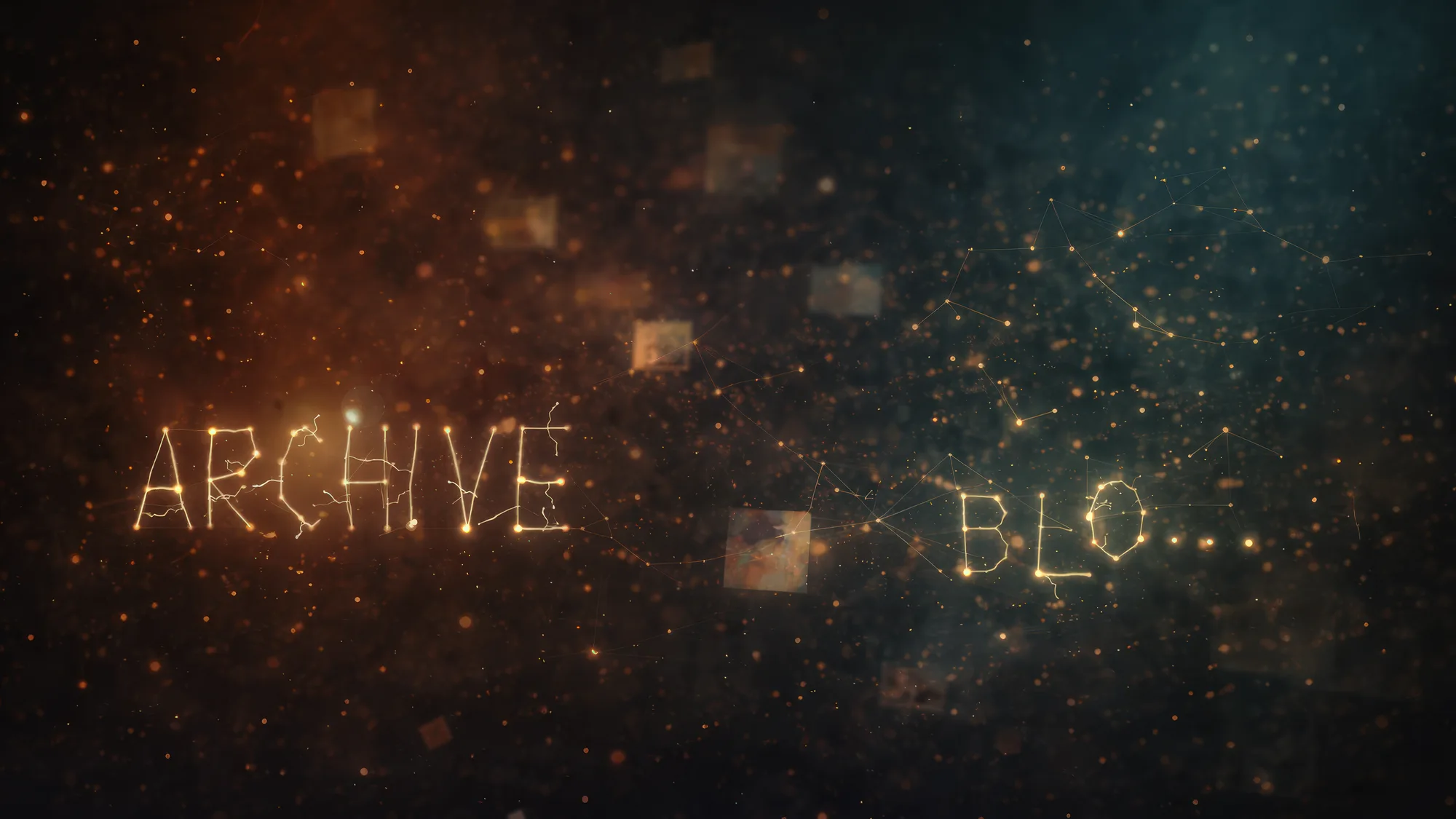
The one place where the site becomes more openly symbolic is the menu. The whole project is called The Winding Room, and that title is really a metaphor for the mind - my mind, specifically. For how thoughts, memories, feelings, ideas, fragments and patterns move around in there, connect, disconnect, loop back, and form meaning. I wanted the menu to reflect that. So words don’t just sit there statically; they emerge from particles, and the connecting lines between them form the language, almost like neurons firing and linking up to create memory, meaning, association. It’s one of the parts of the site where the metaphor becomes visible.
And maybe that is really what this whole site is about: not presenting a finished identity, but creating a space that reflects process. Something that keeps changing. Something that reacts. Something that doesn’t pretend life or work are ever really done.
I’m not a programmer. A few years ago, I would not have been able to build this. That’s simply true. And one of the most exciting things for me about current AI tools is that they made it possible for me to realize a vision like this even without coming from a coding background. Not by replacing my ideas, but by helping me shape them into something functional. That part feels genuinely empowering.
So this site is not a finished monument. It’s a work in progress, and I actually want it to stay that way. Because that feels closer to life. Closer to how the mind works. Closer to how creative work really happens: shifting, adapting, growing, shedding skin, picking up new layers.
That’s what The Winding Room is.
Not a polished conclusion.
More like an open system.
An archive.
A conversation.
A room you can wander.